AI in call centres is reshaping customer service from the ground up. What used to be seen as a pure cost centre is now becoming a strategic growth engine, powered by intelligent automation and data-driven insights. Instead of replacing people, the most successful call centres use AI in call centres to augment human agents, reduce repetitive work, and deliver faster, more personalised support at scale. For a detailed Metapress breakdown of AI call center advantages, including insights on omnichannel customer journeys, this guide provides actionable perspectives.
This guide walks through what AI in call centres really means, the concrete benefits it brings, and how you can implement it in a practical, low-risk way.
Modern AI technologies in contact centres go beyond simple chatbots or automatic call routing. Many organisations are now exploring cloud-based computing solutions for faster processing to ensure that AI can analyse large volumes of customer interactions in real time. By leveraging advanced algorithms, businesses can personalise responses, anticipate customer needs, and provide seamless service across multiple channels.
Implementing AI effectively also means integrating high-performance computing platforms that scale efficiently to handle complex data patterns without slowing down response times. These systems allow contact centres to manage thousands of simultaneous conversations while maintaining high-quality support.
Equally important is using AI insights for strategy. Many companies turn to marketing strategies designed to boost customer engagement by analysing customer behaviour and tailoring offers or recommendations based on their preferences. AI doesn’t just automate tasks; it informs smarter decision-making for every customer touchpoint.
For brands looking to refine operational efficiency, AI-driven marketing tools for improving customer journey mapping can highlight areas where human agents may need support or where automation can increase speed without compromising satisfaction. This combination of human and AI collaboration transforms traditional call centres into agile service hubs.
Finally, successful AI deployment often requires access to top financial resources and investment guides for tech adoption. Understanding the cost-benefit and long-term ROI of AI in contact centres ensures that businesses can make sustainable, data-backed choices while continuously improving the customer experience.
By embracing these modern AI practices, contact centres are no longer just service points—they become strategic partners in delivering consistent, personalised, and efficient customer interactions, making AI in contact centres not just a technology upgrade, but a competitive advantage.
Top 10 AI in Contact Centres Solutions
Artificial intelligence is transforming the way businesses manage customer interactions, making call centre operations more efficient, personalised, and scalable. Here’s a list of the top AI-powered contact centre solutions to consider for modern customer service.
1. Bright Pattern
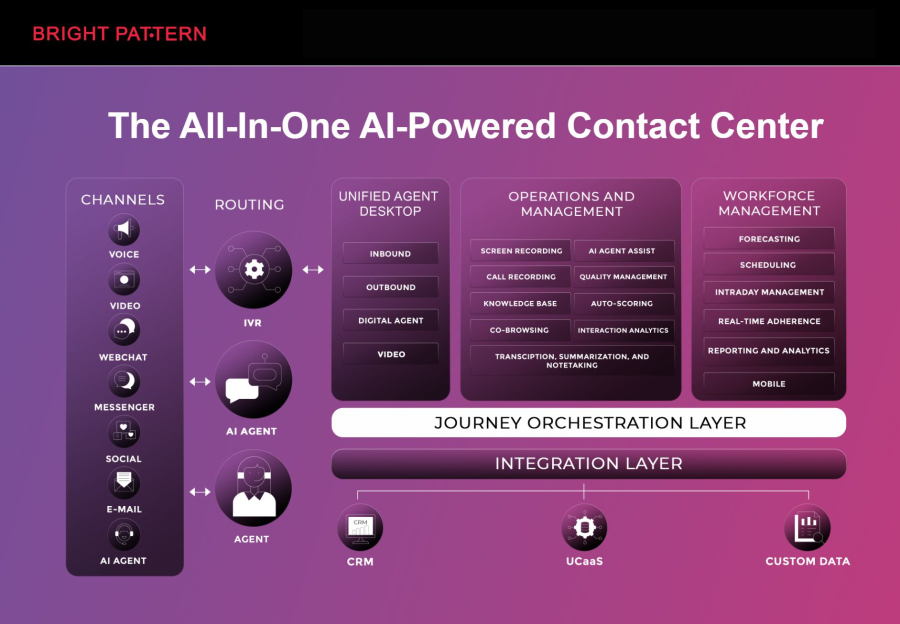
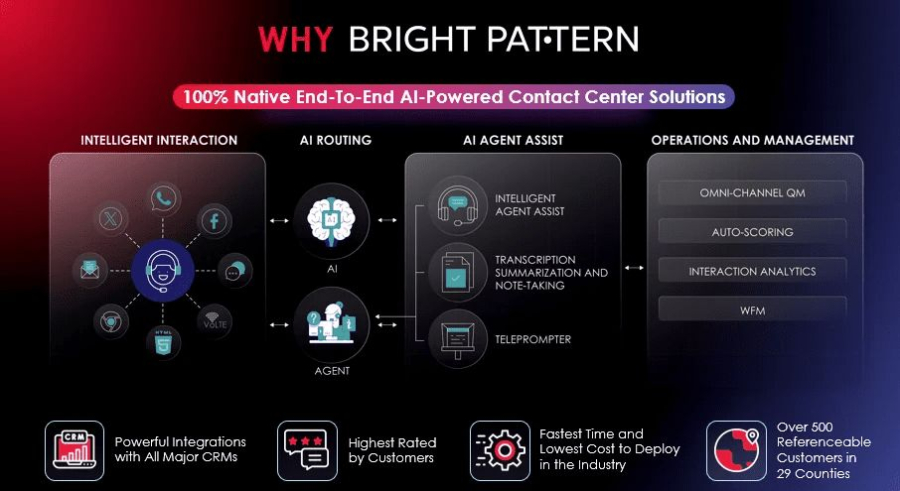
Bright Pattern is a leading provider of AI in contact centres, helping businesses deliver seamless, omnichannel customer experiences. Their platform integrates intelligent automation, predictive routing, and advanced analytics to support agents and improve customer satisfaction.
Key features include:
- Omnichannel communication: Manage voice, chat, email, and social interactions in one platform
- AI-assisted agents: Use predictive responses and real-time suggestions to reduce call handling times
- Advanced analytics: Gain insights into customer trends and agent performance
- Integration capabilities: Connect easily with CRM, helpdesk, and other enterprise systems
- Scalable solutions: Support for businesses of all sizes, from small teams to large enterprises
Bright Pattern’s platform enables contact centres to leverage AI to automate repetitive tasks while enhancing agent efficiency, making it one of the most advanced solutions for modern customer service operations.
2. Genesys
Genesys provides AI-driven customer experience and contact centre software, focusing on routing, workforce optimization, and analytics to improve both agent productivity and customer satisfaction.
3. Five9
Five9 combines cloud contact centre technology with AI tools to streamline workflows, offer intelligent virtual agents, and provide insights for better decision-making.
4. NICE inContact
NICE inContact CXone offers a unified cloud contact centre solution with AI capabilities for predictive routing, automated workflows, and real-time agent assistance.
5. Talkdesk
Talkdesk uses AI to enhance customer service through automated interactions, conversational AI, and real-time analytics to improve call handling and engagement.
6. RingCentral Contact Center
RingCentral Contact Center provides AI-powered tools for workforce optimization, performance analytics, and customer journey tracking to improve operational efficiency.
7. 8x8 Contact Center
8x8 delivers AI-enhanced cloud contact centre software, offering virtual agents, sentiment analysis, and omnichannel support to streamline customer service.
8. Vonage Contact Center
Vonage integrates AI and analytics into its contact centre solutions, enabling automated workflows, predictive routing, and agent assistance tools for smarter customer interactions.
9. Cisco Contact Center
Cisco provides AI-driven contact centre solutions that focus on multichannel engagement, intelligent routing, and workforce optimization to increase operational efficiency.
10. Aspect Software
Aspect Software leverages AI to provide predictive analytics, automated workflows, and agent guidance tools to enhance both customer experience and contact centre performance.
What Does “AI in Call Centres” Actually Mean?
When people talk about AI in call centres, they often picture a single chatbot. In reality, call centre AI is aset of technologiesworking together across voice and digital channels. Common components include:
- Virtual agents and chatbotsthat handle routine questions via voice or messaging.
- Intelligent IVR(Interactive Voice Response) that understands natural language instead of rigid keypad menus.
- Agent assist toolsthat listen to live calls, surface suggestions, and automate after-call work.
- AI-powered routingthat matches customers with the best agent based on skills, history, and urgency.
- Speech and text analyticsthat analyse 100% of interactions for trends, quality, and compliance.
- Workforce optimisationmodels that forecast demand and optimise staffing.
Together, these tools allow call centres to respond faster, personalise experiences, and operate more efficiently without sacrificing human empathy.
Key Benefits of AI in Call Centres
1. Faster Response Times and Lower Wait Times
Nothing frustrates customers more than long queues. AI dramatically reduces waiting by:
- Deflecting repetitive queriesto virtual agents so human agents focus on complex cases.
- Automating identity verificationand data lookup before the call reaches an agent.
- Prioritising urgent contactsusing sentiment and context analysis.
Customers get answers faster, and agents are not overwhelmed by high call volumes.
2. 24/7, Always-On Support
AI-powered virtual agents never sleep. They can offer:
- Round-the-clock self-servicefor common requests like balance checks, order status, or simple troubleshooting.
- Seamless escalationto live agents when needed, with full context passed along.
- Consistent service qualityregardless of time of day or peak periods.
This is especially powerful for global businesses and digital-first customers who expect instant answers at any hour.
3. Happier, More Effective Agents
AI is a powerful ally for agents, not a replacement. Deployed well, it makes their jobs easier and more rewarding by:
- Eliminating repetitive taskssuch as manual note-taking and data entry.
- Providing real-time guidanceduring calls (for example, next-best actions or suggested responses).
- Surfacing knowledge instantlyinstead of agents hunting through multiple systems.
- Reducing handle timeso agents can focus on empathy and problem-solving.
When agents feel supported and can resolve issues faster, bothemployee satisfactionandcustomer satisfactiontend to rise together.
4. Higher First-Contact Resolution (FCR)
AI improves the chance that a customer’s issue is resolved in a single interaction. It does this by:
- Automatically pulling customer historyand relevant context before the agent says hello.
- Recommending personalised solutionsbased on similar resolved cases.
- Ensuring consistent answersacross agents and channels, based on a unified knowledge base.
Higher FCR means fewer repeat calls, lower operational costs, and more loyal customers.
5. Better Insights From Every Interaction
Traditionally, quality teams could only manually review a small sample of calls. AI changes that by enabling:
- Speech and text analyticsacross 100% of calls, emails, and chats.
- Real-time dashboardsthat highlight emerging issues and trends.
- Objective quality monitoringusing consistent criteria.
Leaders gain a rich view of customer sentiment, product pain points, and agent performance, turning the call centre into astrategic listening postfor the entire business.
6. Lower Operational Costs (Without Cutting Quality)
AI-driven call centres are more efficient, which means you can do more with the same or fewer resources:
- Handle more contacts per agentthanks to automation and decision support.
- Reduce overtime and staffing peakswith accurate demand forecasting.
- Automate back-office worklike case creation, tagging, and after-call wrap-up.
The result is a lower cost per contact while maintaining a high standard of service.
Practical AI Use Cases in Modern Call Centres
AI can be applied at almost every stage of the customer and agent journey. Here are some of the most impactful use cases.
Intelligent IVR and Virtual Agents
Modern IVR systems can understand phrases like “I want to update my address” instead of asking customers to “Press 1, press 2, press 3.” Virtual agents then:
- Authenticate the customer.
- Retrieve account information.
- Handle the request end-to-end or route to the right agent.
This reduces friction for customers and helps them avoid complex menu trees.
Real-Time Agent Assist
Agent assist tools use AI to listen (or read) in real time and provide:
- Suggested repliesbased on the conversation.
- Knowledge articlesrelevant to the customer’s question.
- Compliance promptsthat remind agents to read disclosures or verify information.
- Automatic summarisationof the interaction for faster wrap-up.
This shortens training time for new agents and standardises quality across the team.
Smart Routing and Prioritisation
AI-powered routing engines move beyond simple skill-based rules. They can:
- Analyse customer history and intentto decide where to send each contact.
- Consider agent strengths, performance, and workload.
- Factor in business prioritiessuch as VIP status or high-value opportunities.
The result is shorter handling times, better customer-agent fit, and increased conversion for sales-oriented calls.
Proactive Outreach
Instead of waiting for customers to call with problems, AI helps call centres act proactively by:
- Predicting churn riskand prompting agents to reach out with retention offers.
- Flagging products or servicesthat would genuinely benefit a customer based on behaviour and history.
- Triggering notificationswhen there are service disruptions, billing changes, or important updates.
Proactive service often leads to higher loyalty and more profitable relationships.
Quality Assurance and Coaching
AI transforms quality assurance from manual sampling to continuous improvement by:
- Scoring interactions automaticallyon criteria like empathy, compliance, and resolution.
- Highlighting coaching momentsand creating personalised training plans.
- Identifying best practicesfrom top-performing agents and sharing them across the team.
Managers can focus on strategic coaching rather than basic monitoring.
AI vs Traditional Call Centres: A Side-by-Side View
The shift from traditional operations to AI-enhanced call centres can be summarised at a glance:
| Area | Traditional Call Centre | AI-Enhanced Call Centre |
| Availability | Business hours, limited after-hours support | 24/7 via virtual agents, with smart escalation to humans |
| Routing | Basic skills and queue-based routing | Intent, sentiment, and value-based routing to best-fit agents |
| Agent Support | Manual searches, static scripts | Real-time suggestions, dynamic knowledge, auto-summaries |
| Quality Monitoring | Small sample of calls, manual scoring | Automated scoring and analytics across all interactions |
| Customer Experience | Longer waits, repetitive questions | Faster answers, personalised service and less repetition |
| Cost Structure | Higher costs per contact, labour-driven | Lower costs per contact through automation and efficiency |
How to Successfully Implement AI in Your Call Centre
Implementing AI is not about buying a tool and switching it on. The most successful programmes follow a structured, business-led approach.
1. Start With Clear Business Goals
Before choosing technology, define what you want to achieve. Common goals include:
- Reducing average handle time.
- Improving first-contact resolution.
- Cutting call volumes for simple queries.
- Boosting customer satisfaction scores.
- Shortening new agent ramp-up time.
These goals will guide your choice of AI use cases and help you measure success.
2. Choose High-Impact, Low-Risk Use Cases First
Momentum matters. Start with AI applications that:
- Touch clear, repetitive processes (password resets, order tracking, policy questions).
- Do not require deep system changes.
- Are easy to measure (for example, deflection rate, handle time reduction).
Quick wins build internal support and free up budget for more advanced projects.
3. Involve Agents Early and Often
Agents are the experts in your customers and your processes. Engage them by:
- Collecting ideas on tasks they would like to automate.
- Piloting agent assist tools with enthusiastic early adopters.
- Sharing how AI will reduce low-value work, not take away jobs.
When agents feel included, they become strong champions for AI-powered change.
4. Integrate With Core Systems and Data
The real power of AI arrives when it is connected to your existing ecosystem, such as CRM, ticketing, and knowledge management platforms. Integration enables:
- Personalised experiencesbased on full customer history.
- Accurate reportingthat unifies data from all channels.
- End-to-end automationfrom customer request to resolution.
Strong data foundations and clean processes amplify every AI investment.
5. Measure, Learn, and Continuously Improve
AI systems improve over time as they receive feedback and more examples. Build continuous improvement into your operations by:
- Reviewing performance dashboards regularly.
- Fine-tuning models based on agent and customer feedback.
- Adding new intents and scenarios to virtual agents as products evolve.
Think of AI as a living capability that grows with your organisation.
Key Metrics to Track for AI-Driven Call Centres
To prove value and refine your approach, it is essential to track the right metrics. Useful measures include:
- Average handle time (AHT)before and after AI deployment.
- First-contact resolution (FCR)rate improvements.
- Self-service and deflection ratesfor virtual agents and knowledge tools.
- Customer satisfaction (CSAT) and Net Promoter Scorefor AI-assisted interactions.
- Agent satisfactionand turnover rates.
- Cost per contactand overall operational savings.
These metrics not only demonstrate return on investment but also highlight where to focus future optimisation efforts.
Real-World Style Scenarios: What Success Looks Like
Scenario 1: Reducing Call Volume With Virtual Agents
A retail company receives thousands of calls each week about order status and returns. By introducing an AI-powered virtual agent that can:
- Identify the customer using order number or phone match.
- Provide real-time order tracking.
- Initiate returns and send labels automatically.
The company quickly diverts a significant portion of these contacts away from human queues. Agents are then free to focus on high-value interactions such as product advice and complex issues, improving revenue and satisfaction.
Scenario 2: Empowering New Agents With Real-Time Guidance
A financial services call centre struggles with lengthy training and inconsistent quality from new hires. After deploying an AI agent assist tool that:
- Suggests compliant phrasing and required disclosures.
- Highlights relevant policy documents based on call context.
- Auto-generates call summaries and next steps.
The organisation cuts new agent ramp-up time and sees more consistent adherence to regulatory guidelines, all while keeping customer experiences smooth and professional.
Future Trends: Where AI in Call Centres Is Heading Next
AI in call centres is evolving rapidly, with several promising trends on the horizon:
- More natural conversationsas speech recognition and language models become increasingly accurate.
- Unified omnichannel experienceswhere AI remembers context across phone, chat, email, and social.
- Deeper personalisationbased on predictive models that anticipate needs before customers ask.
- Voice biometrics and smarter securitythat makes authentication both safer and faster.
- Hyper-automationconnecting front-office interactions with back-office workflows end-to-end.
Organisations that invest now in foundational AI capabilities and data quality will be well positioned to take advantage of these advances.
Frequently Asked Questions About AI in Call Centres
Will AI replace human call centre agents?
In practice, AI is most effective when itsupportshuman agents rather than replaces them. Virtual agents handle routine, repetitive tasks, while humans focus on complex, emotional, or high-value interactions. This combination creates better experiences for both customers and employees.
How difficult is it to get started?
Getting started can be surprisingly manageable when you focus on a few targeted use cases and work with existing systems. Many organisations begin with a simple virtual agent for common questions or an agent assist pilot and then expand gradually based on results.
Is AI suitable for small or mid-sized call centres?
Yes. AI is no longer just for large enterprises. Cloud-based solutions and modular tools allow smaller call centres to adopt AI in stages, paying only for what they use and scaling as they grow.
How does AI impact customer satisfaction?
When deployed thoughtfully, AIimprovessatisfaction by reducing wait times, enabling 24/7 support, and ensuring more consistent, accurate answers. The key is to keep escalation paths to human agents clear and easy whenever customers need them.
Conclusion: Turning Your Call Centre Into a Strategic Advantage
AI is transforming call centres from reactive, cost-heavy operations into proactive, insight-rich environments that delight customers and empower employees. By combining intelligent automation with human empathy, organisations can:
- Deliver faster, more personalised support.
- Reduce operational costs without sacrificing quality.
- Boost both customer loyalty and agent engagement.
- Unlock powerful insights that guide broader business strategy.
The most successful call centres will not be the ones with the most technology, but the ones that use AI strategically to bring out the best in their people and processes. Now is the ideal time to explore where AI can add value in your own operations and build a roadmap toward a smarter, more resilient call centre.
